

Company Registration in Coimbatore, Chennai & Bangalore – Complete 2026 Guide

India’s business landscape is shifting fast. While Mumbai and Delhi continue to hold their ground as financial powerhouses, three cities in South India have quietly emerged as the most entrepreneur-friendly destinations in the country — Coimbatore, Chennai, and Bangalore. Whether you are a textile manufacturer in Coimbatore, a fintech founder in Chennai, or a SaaS builder in Bangalore, 2026 offers the most streamlined company registration process India has ever seen.
This guide is built for founders and business owners across all three cities — covering what makes each location unique, and walking you through the registration process step by step.
Why These Three Cities Are Dominating South India’s Business Story
Company Registration in Coimbatore is gaining momentum fast. Known for textiles, pumps, and engineering goods, Coimbatore is now expanding into technology, healthcare, and education. Lower operational costs, a strong MSME ecosystem, and growing investor interest make it an ideal city for founders who want serious scale without metro-level chaos.
Company Registration in Chennai opens doors to one of South India’s most powerful business ecosystems. As Tamil Nadu’s commercial capital, Chennai leads in IT, automotive, healthcare, and manufacturing. With world-class port infrastructure, enterprise client access, and the Tamil Nadu government’s startup-friendly policies, it remains one of India’s most connected cities for business.
Company Registration in Bangalore is the first move every tech founder should make. India’s startup capital offers a dense network of investors, accelerators, and top-tier product talent. If your business is built on software, AI, or deep tech, Bangalore puts you right at the center of India’s innovation economy.
Step 1 — Choose the Right Business Structure
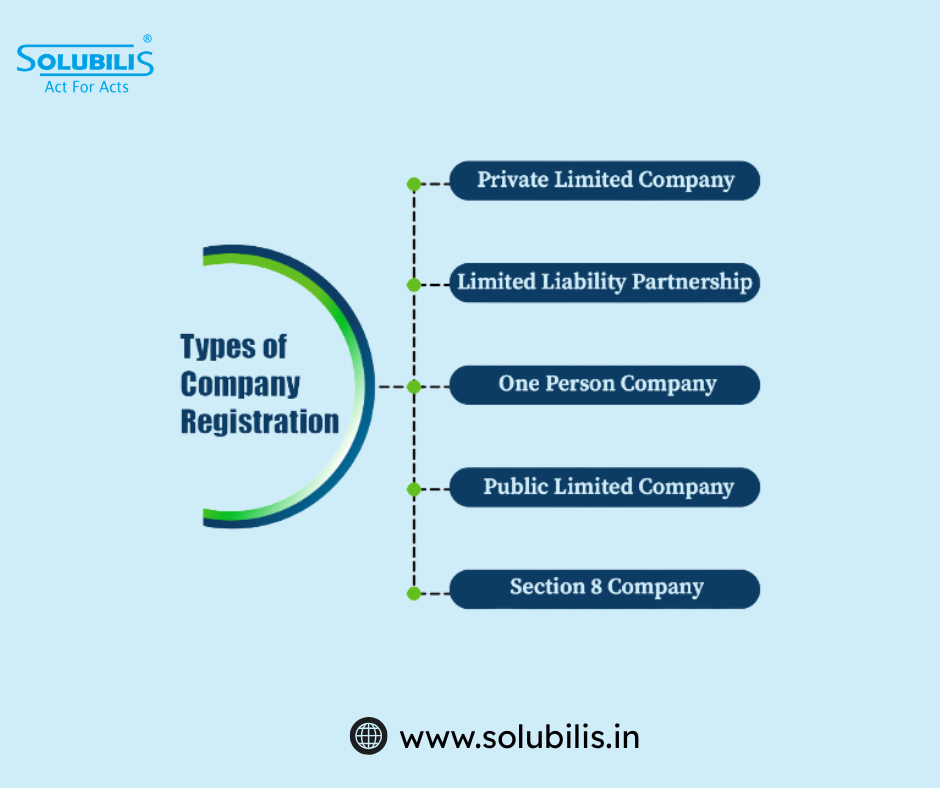
Regardless of which city you are registering in, the business structure you choose will be the same — company registration in India is governed centrally by the Ministry of Corporate Affairs (MCA). Here are the main options:
Private Limited Company — The most preferred structure for growth-oriented businesses. Offers limited liability, separate legal identity, and is the only structure most investors will consider. If you plan to raise funding or build a scalable business, choose this.
One Person Company (OPC) — Designed for solo founders who want the protection of a company structure without needing a co-founder or second director. Ideal for independent consultants, freelancers going formal, and solo product builders.
Limited Liability Partnership (LLP) — Best suited for professional service firms and partnerships. Offers flexibility in profit-sharing and has lower compliance requirements than a private limited company. Popular among CA firms, law practices, and design studios.
Sole Proprietorship — The simplest and most informal structure. No separate legal identity, no liability protection. Suitable only for very early-stage or micro businesses with limited transaction volumes.
For most founders in Coimbatore, Chennai, and Bangalore, a Private Limited Company is the structure that best supports long-term ambitions.
Step 2 — Obtain Digital Signature Certificates (DSC)
Every proposed director of the company needs a Digital Signature Certificate before any filing can happen. The DSC serves as your verified electronic identity on the MCA portal.
You apply through a government-approved certifying authority by submitting:
- PAN card
- Aadhaar card
- Passport-sized photograph
- Mobile number and email for OTP verification
DSCs are typically ready within one to two working days and are valid for two years from the date of issue.
Step 3 — Reserve Your Company Name
Your company name must be unique, non-deceptive, and compliant with MCA naming rules. Use the MCA portal or the RUN (Reserve Unique Name) service to check availability before applying.
A few naming tips:
- The name must end with “Private Limited” for a private company
- Avoid names that are identical or phonetically similar to existing companies
- Do not use restricted words like “National,” “Government,” “Bank,” or “Insurance” without regulatory approval
- Keep it short, distinctive, and easy to spell — your company name is also your first brand impression
Step 4 — Prepare Your Foundational Documents
Two documents define what your company is and how it operates:
Memorandum of Association (MoA) — Describes the company’s name, registered office address, main objectives, and the nature of business activities it is authorized to carry out.
Articles of Association (AoA) — Sets out the internal governance rules: how directors are appointed, how meetings are conducted, how shares are transferred, and how decisions are made.
Both documents are submitted electronically as eMoA and eAoA through the SPICe+ portal.
Step 5 — File the SPICe+ Form
SPICe+ (Simplified Proforma for Incorporating Company Electronically Plus) is the single integrated form that handles company registration across India — whether you are in Coimbatore, Chennai, or Bangalore. It covers:
- Company incorporation with the Registrar of Companies (RoC)
- PAN and TAN allotment
- Director Identification Number (DIN) for up to three directors
- GST registration (optional at this stage)
- EPFO and ESIC registration
- Professional Tax registration (applicable in Karnataka for Bangalore-based companies)
- Bank account opening linkage
This one form replaces what used to require multiple applications across different departments. The shift to SPICe+ has been one of the most impactful reforms in Indian company law over the last few years.
Step 6 — Receive Your Certificate of Incorporation
After your SPICe+ application, eMoA, eAoA, and supporting documents are reviewed and approved by the respective Registrar of Companies — RoC Chennai for Tamil Nadu-based companies, and RoC Bangalore for Karnataka-based companies — you receive your Certificate of Incorporation.
This document officially brings your company into legal existence and includes your unique Corporate Identification Number (CIN). In 2026, approvals for well-prepared filings typically arrive within four to seven working days.
City-Specific Registrations to Keep in Mind
While the core incorporation process is the same across all three cities, there are a few location-specific registrations worth noting:
Coimbatore & Chennai (Tamil Nadu)
- The Tamil Nadu government handles Professional Tax registration.
- Businesses must obtain Shops and Establishments registration if they have employees.
- Manufacturing and service businesses should obtain MSME Udyam registration to access government schemes and priority lending.
Bangalore (Karnataka)
- Karnataka levies Professional Tax on salaried employees — the company must register as a Professional Tax employer
- Shops and Establishments Act registration applies to all commercial establishments
- Startups can register under Karnataka’s Elevate and Startup Karnataka programs for additional support and funding access
Post-Incorporation Checklist
Once you have your Certificate of Incorporation in hand, do not stop there. These steps need to happen quickly:
- Open a Current Bank Account in the company’s name using your CIN, PAN, and KYC documents
- File INC-20A — Declaration of Commencement of Business — within 180 days. This is mandatory. Missing it attracts a ₹50,000 penalty for the company and daily fines for directors.
- Apply for GST Registration if your expected annual turnover crosses ₹20 lakhs (₹10 lakhs for service businesses in special category states)
- Hold the First Board Meeting within 30 days of incorporation and maintain proper minutes
- Issue Share Certificates to all founding shareholders within 60 days
- Register for MSME (Udyam) if applicable — it unlocks credit guarantees, government tenders, and priority sector benefits
Common Mistakes That Delay Registration
Across Coimbatore, Chennai, and Bangalore, these are the errors we see most often:
- Name conflicts with existing trademarks or companies — always do a thorough search before applying
- Mismatch between the name on Aadhaar and PAN — these must match exactly
- Incorrect registered office address documentation — you need a valid utility bill and a No Objection Certificate from the property owner
- Companies often forget to file INC-20A after incorporation, making it one of the most commonly missed post-incorporation compliances.
- Not applying for GST on time — delays can cost you clients who require a GSTIN on invoices
How Solubilis Makes This Easy
At Solubilis, we have helped businesses across Coimbatore, Chennai, and Bangalore go from idea to incorporated company — quickly, cleanly, and without the usual paperwork headaches. Our team manages the entire process: DSC procurement, name reservation, SPICe+ filing, MoA and AoA drafting, and post-incorporation compliance.
We understand that every city has its own business culture and regulatory nuances. Whether you are setting up a manufacturing unit in Coimbatore, a tech company in Bangalore, or a trading firm in Chennai, we tailor our approach to your specific situation.
Beyond incorporation, Solubilis supports you with GST registration and filing, trademark registration, ROC annual compliance, and accounting services — everything a growing business needs under one roof.
Ready to register your company in Coimbatore, Chennai, or Bangalore? Contact the Solubilis team today and get it done right.